
A footer logo is an image file. Nobody licenses an image file. Regulators licence a company, and that company's name and licence number are the only two things worth writing down before you look anywhere else on the site. This is the first of the five checks, and it takes longer to explain than to do — on most sites it is a five-minute job once you know where to look.
Start in the footer, not the homepage
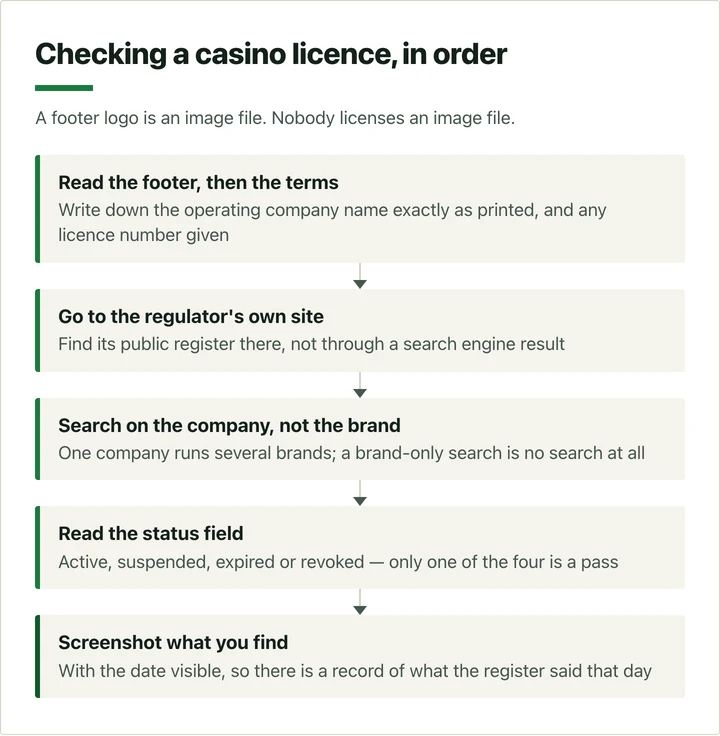
Scroll to the very bottom of the casino's homepage. Past the payment logos and the age badge there is usually a paragraph of small print, and somewhere in it a sentence built roughly like this: "Brand X is owned and operated by Y Entertainment N.V." That company name, Y Entertainment N.V. in the example, is what you are actually checking. The brand name at the top of the page is marketing. The company name in that sentence is the legal entity that holds, or does not hold, the licence.
The licence number sits nearby, sometimes in the same sentence, sometimes one line further down next to the words "licence number" or "authorised and regulated by". If the footer is thin, the terms and conditions almost always carry the same detail in their opening clause, where a document defines who "we", "us" or "the operator" means for the rest of the page. That clause is worth reading even when the footer looks complete, because it is the version the operator would point to if there were ever a dispute.
If you cannot find a company name or a licence number anywhere on the site after checking the footer and the terms, that absence is the finding. Write it down and stop there — there is nothing left to look up.
Match the company, not the brand
One company can run several brands at once, and a brand can keep its name and its logo long after the company behind it has changed. A register search on the brand name alone can return nothing even when a genuine licence exists, and it can also return nothing because the licence genuinely does not exist — the search will not tell you which. Search the register on the company name from the footer, not the brand name from the homepage, and treat a brand-only search as no search at all.
Some operators state the licence number without stating which regulator issued it, or name a regulator without giving a number. Either gap is enough to fail this check on its own. A licence number without a named regulator cannot be looked up, and a regulator without a number cannot be matched to a specific entry rather than a general claim.
Look it up in the right register
Which register depends on which regulator the site names. Go to that regulator's own public register directly rather than trusting a search engine result, since some third-party pages mirror old or incomplete data.
| Regulator named | Search on | What a pass looks like |
|---|---|---|
| Gambling Regulatory Authority of Ireland (GRAI) | Company name | Active licence record under that company. As of this note, GRAI's licensing regime is still being introduced in stages, so not every category of operator will have an Irish entry yet — see the Irish situation below |
| UK Gambling Commission | Company name or licence number | A public register entry showing the licence as current, with the licensed company name matching the footer exactly |
| Malta Gaming Authority | Company name or licence number | An entry showing the licence as active, with the same company name as the footer |
| Curaçao Gaming Authority | Company name or licence number | An entry under the current licensing framework — treat any older-style sub-licence number with no matching entry as a gap, not a pass. The framework there has been reformed, so use the authority's own current search page rather than a list copied from elsewhere |
If the site names a regulator that is not one of these, that is not automatically a red flag, but it does mean starting from the regulator's own website to find its register in the first place, rather than a search engine result, which is where copies of outdated or fake register pages tend to surface.
Read the status, not just the presence
Finding an entry at all is not the same as finding a passing one. A register entry can say active, suspended, expired or revoked, and only one of those four is a pass. A suspended or revoked licence still shows up in a search; the whole point of reading the status field is that the entry existing proves the company was licensed at some point, not that it is licensed now.
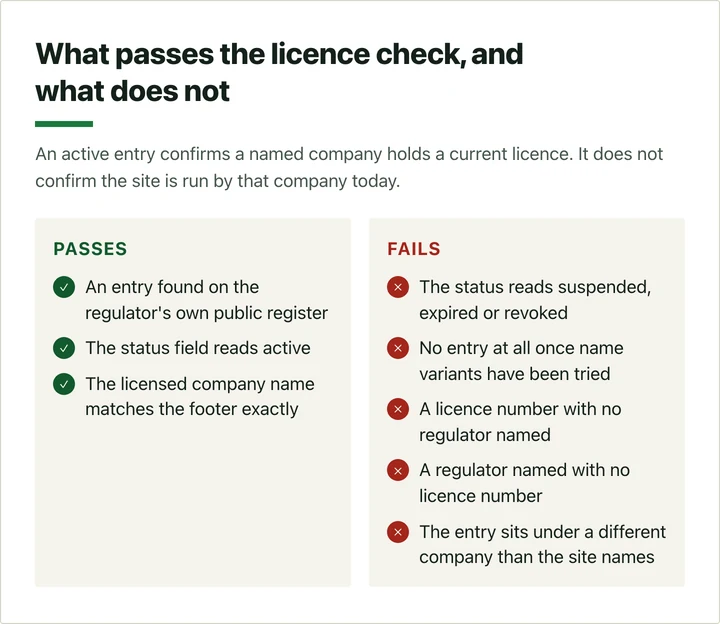
An active entry also has a narrower meaning than it looks like it has. It confirms that a named company currently holds a current licence from that regulator. It does not confirm that the website you are looking at is genuinely run by that company today, that the site's other claims are accurate, or that the operator will handle a withdrawal well — those are separate questions, covered by the other checks in the method.
What a missing or dormant entry means
Three things can produce a blank search result: the operator never held a licence from that regulator, the licence lapsed and was not renewed, or the company name was typed slightly wrong on the site or in the search box. Try the search again with small variations — dropping "Ltd" or "N.V.", checking for a trading-name field on the register itself — before concluding the entry is genuinely missing.
Once a genuine miss is confirmed, though, it is a serious one. A site naming a regulator it is not actually licensed by is not a clerical slip; it is a false claim made to a player deciding whether to deposit. A dormant or revoked entry is milder but still a fail: the licence that once justified the site's claim no longer does, and nothing on the homepage will tell you that on its own.
The Irish situation
Ireland's gambling licensing framework is newer than the UK's or Malta's. The Gambling Regulation Act 2024 created the Gambling Regulatory Authority of Ireland, and GRAI is bringing its own licensing regime in by stages rather than all at once — which categories are live when you read this is worth checking on GRAI's own site. In practice this means a site serving Irish players today may hold no Irish licence at all, and that is not automatically a fail on its own: it can simply mean the Irish regime has not reached that category of operator yet.
What it does mean is that the licence actually protecting an Irish player right now is very often a foreign one — most commonly a UK Gambling Commission licence, since Irish players see GB-licensed sites constantly, or a Malta or Curaçao licence. Check whichever licence the site actually names, in that regulator's own register, rather than waiting for an Irish entry that may not exist yet. A GB licence also carries UK consumer-protection rules and access to GAMSTOP's self-exclusion scheme, which Ireland does not yet have a national equivalent of — more on that in responsible gambling.
Why a footer logo proves nothing
Regulator badges and licence-body logos are image files that any site can upload, styled or resized however the operator likes, with or without a genuine licence behind them. Some regulators publish an official badge with an embedded link back to the live register entry for that exact licence; most older or lower-tier regulators do not, which means the badge itself carries no more weight than any other picture on the page. Treat every badge the same way: as a pointer to go and check, never as the check itself.
What if the footer names a company but I can't find a licence number at all?
Treat it the same as a missing entry. A company name without a licence number is not enough to search a register properly, and the gap itself is the finding worth noting down.
Does an active register entry mean the casino is safe to use?
It means the licence check passes, which is one of five. Terms, cash-out rules, support and the safer-play tools are separate checks, and a site can pass this one and fail any of the others.
Can I trust a licence claim I found on a comparison or review site instead?
No. Go to the operator's own site for the company name and licence number, then to the regulator's own register to check them. Third-party pages can be out of date or simply wrong, and neither error shows up unless you check the source directly.
What to do next
- Open the casino's footer and its terms and conditions, and write down the operating company name exactly as printed, along with any licence number given.
- Go to the named regulator's own website, not a search engine result, and find its public register.
- Search the register on the company name, check the status field, and screenshot what you find with the date.
- If the entry is missing, dormant or under a different company than the one named on the site, treat that as a fail and stop — there is no reason to check the other four points on a site that cannot clear the first one.
- If it passes, move on to the terms behind any offer and the withdrawal rules before depositing anything, both covered in the rest of the method.
18+ only. If any part of this is about money you cannot afford to lose rather than money you have decided to risk, read responsible gambling before you go any further. For more on who runs these checks, see the author page, and for what this site is and is not, see about the desk.