
Third check on the doorstep test is the way out: withdrawal limits, verification requirements, the pending or reversal period, and any fee. All four should be readable before an account exists. Not after depositing, not after winning, and not only once you have already clicked "withdraw" and hit a wall.
This is the check most complaints trace back to. A licence problem is rare and usually obvious once you look. A bonus term problem costs you the offer. A cash-out problem shows up after you have already won, when the money that should be yours is sitting behind a rule you never saw — and by then you are arguing from a worse position than you started in.
Why this check comes third, not last
The licence check tells you whether the operator is who it says it is. The bonus terms check tells you what the offer actually costs. Neither one tells you what happens when you try to take money back out, and that is a separate question with its own separate page, usually written by a different part of the same company. Skipping it because the licence looked fine is the single most common way this test gets half-done.
Where the rules usually live
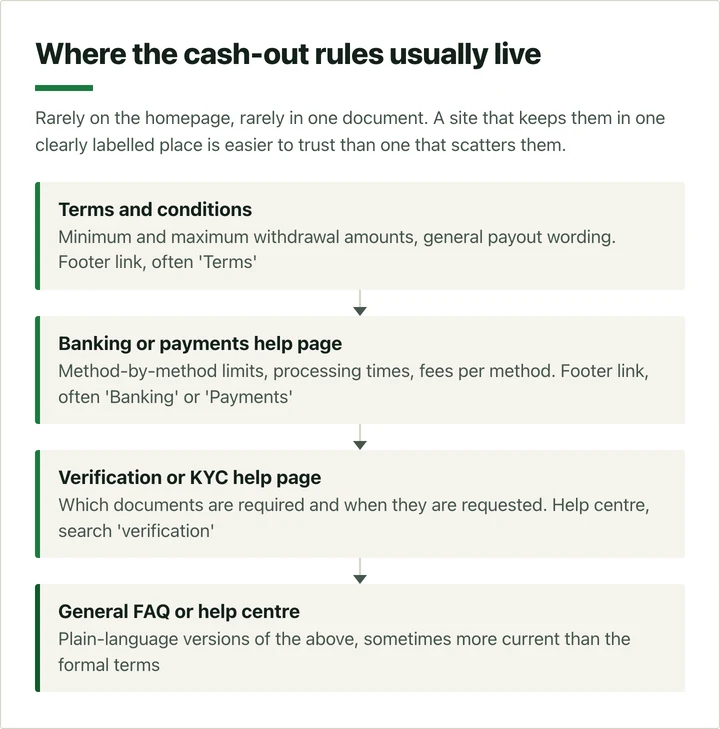
Cash-out rules are rarely on the homepage and rarely in the main terms and conditions document in full. They are more often split across two or three pages, which is itself worth noting: a site that keeps its withdrawal rules in one clearly labelled place is easier to trust than one that scatters them.
| Page | What it usually shows | Where to find it |
|---|---|---|
| Terms and conditions | Minimum and maximum withdrawal amounts, general payout wording | Footer link, often "Terms" or "T&Cs" |
| Banking or payments help page | Method-by-method limits, processing times, fees per method | Footer link, often "Banking", "Payments" or "Deposits & withdrawals" |
| Verification or KYC help page | Which documents are required and when they are requested | Help centre, search "verification" or "KYC" |
| General FAQ or help centre | Plain-language versions of the above, sometimes more current than the formal terms | Footer link, often "Help" or "FAQ" |
None of these pages needs a login. If any of them redirects you to a sign-up form, or if the banking page loads only a generic "log in to see your options" message, that is worth writing down before you go any further.
The four things to find
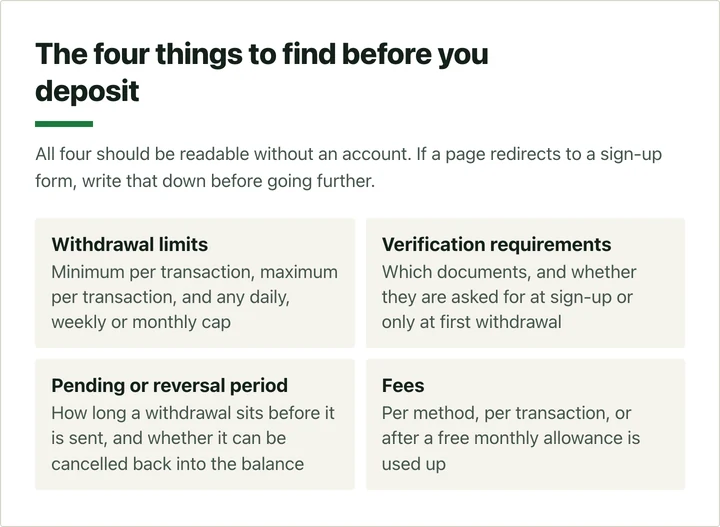
- Withdrawal limits
- Minimum per transaction, maximum per transaction, and any daily, weekly or monthly cap
- Verification requirements
- Which documents, and whether they are asked for at sign-up or only at first withdrawal
- Pending or reversal period
- How long a withdrawal sits before it is sent, and whether you can cancel it back into your balance during that window
- Fees
- Per method, per transaction, or after a free monthly allowance is used up
Withdrawal limits
Look for a minimum and a maximum stated per transaction, and separately for any period cap — daily, weekly or monthly. A low per-transaction maximum next to a much higher period cap means several separate withdrawal requests to get a large win out, each one potentially restarting the pending clock. If the site only states a minimum and says nothing about a maximum, that is not necessarily a fail on its own, but it is a gap worth noting and asking about directly.
Verification requirements
Nearly every licensed operator will ask for proof of identity, proof of address and sometimes proof of the payment method used, at some point. The question is not whether they ask, it is when. A page that lists the documents in advance — typically a photo ID, a recent utility bill or bank statement, and a screenshot or photo of the card or e-wallet used to deposit — lets you gather them before you need them. A site that stays silent on this until a withdrawal is requested is asking you to find out mid-process, which is a worse time to discover a document you do not have.
Verification requested only once you try to withdraw a win, with no advance notice anywhere on the site, is one of the most common patterns behind cash-out complaints. It is not always a sign of bad faith — document checks are a normal anti-fraud step — but a site that explains the process before you deposit is giving you information a site that stays quiet is not.
Pending or reversal period
Most operators hold a withdrawal request for a short period before sending it, during which it can usually be cancelled and the balance returned to the account — a design meant to let a player who changes their mind keep playing rather than wait for a bank transfer to reverse. What matters for this check is whether the length of that period is actually stated, and whether it is presented as normal processing or left vague. "Withdrawals are processed within a stated number of business days" is the kind of sentence you are looking for; the exact figure varies by operator and by payment method, and belongs in the note about the specific site once it is checked, not assumed here.
Fees
Fees, where they exist, are usually attached to a specific method rather than charged across the board: a card withdrawal fee, a fee after a certain number of free withdrawals in a month, or a currency-conversion charge on an account held in a different currency to the payment method. A payments or banking page that lists fees method by method, in the same table as the limits, is doing this properly. A page that mentions fees only as a general disclaimer, with no figures, has not actually told you anything.
Name matching
One rule is worth knowing before you pick a payment method: most licensed operators only pay winnings back out to the same payment method, and the same account name, that the deposit came from. It is a standard anti-money-laundering control, not a site-specific quirk, and it is the reason a withdrawal to a different card or a different bank account than the one used to deposit is commonly refused outright rather than merely delayed. Check that the account name on your payment method matches the name on the casino account exactly, including a maiden name, a hyphenated surname, or a joint account held under two names. A mismatch here is one of the more mundane reasons a withdrawal stalls, and one of the easiest to avoid by checking it before you deposit rather than after you win.
What to screenshot
Do this before you deposit, while the pages are still visible without an account. Terms change, and a screenshot with a visible date is the only record you will have of what a site said on the day you signed up, if it later says something different.
- The banking or payments page showing limits and fees per method, with the page URL and date visible if your screenshot tool captures them.
- The verification or KYC page, or the specific FAQ answer, listing which documents are required.
- Any statement of the pending or reversal period, wherever it appears.
- The terms and conditions section that covers withdrawals, even if it duplicates the above — formal wording sometimes differs from the plain-language help page.
What a fail looks like
None of these on their own proves bad faith. Together, or in the wrong order, they are the pattern worth walking away from.
- Withdrawal limits and fees are not published anywhere that does not require a login.
- Verification documents are never listed in advance, and are only requested once a withdrawal is already in progress.
- No pending or reversal period is stated anywhere, formal terms included.
- The banking page and the terms and conditions page give different numbers for the same limit.
- Support, when asked directly for the withdrawal terms, links back to the same vague page rather than answering the specific question.
Any one of these is a reason to read further before depositing. Two or more, taken together, is usually enough reason not to.
What to do next
- Before you deposit anywhere, find the banking page, the verification page and the withdrawal section of the terms, and screenshot all three.
- Note the limits, the documents listed, the pending period and any fee in one place, before you have a reason to need any of them.
- If a figure is missing rather than just small, treat the gap itself as the answer — ask support directly, in writing, and keep the reply.
- Run the other two checks on the same site: the licence, read properly, and the four numbers behind the bonus. A cash-out policy does not mean much attached to a licence that fails.
The full method behind all of this, including how we keep evidence and how often a page gets re-checked, is on how we test.
18+ only. If any part of this touches money you cannot afford to be without, read responsible gambling before you read anything else on this site.